


Introduction: What’s Really Behind Medical Billing Pricing Models?
If you’re a healthcare provider, clinic manager, or solo practitioner, you’ve probably faced the big question: “Should I pay my billing company a flat fee or a percentage?”
In 2025, medical billing pricing models are evolving fast automation, AI claim scrubbing, and hybrid telehealth billing are changing the game. Understanding these pricing structures isn’t just about saving money it’s about maximizing revenue cycle efficiency, compliance, and patient trust.
This guide breaks down the flat fee vs percentage pricing debate with real insights, pros and cons, and practical tips to help your practice choose the right model.
Understanding Medical Billing Pricing Models
What Is a Flat Fee Billing Model?
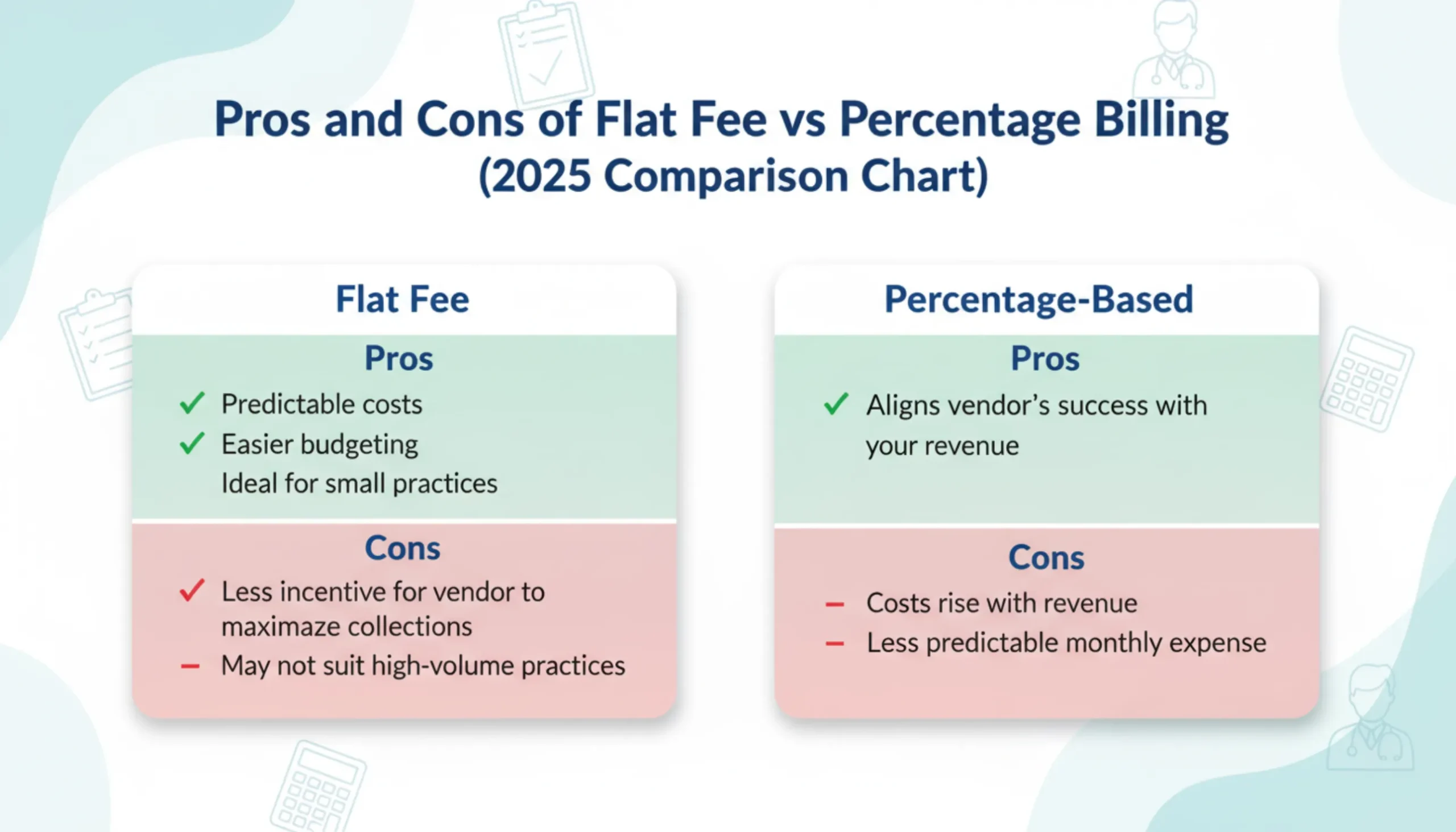
In a flat fee model, your practice pays a fixed monthly amount to the billing company, regardless of the total revenue collected.
Example: A clinic pays $1,000/month for full billing services.
This model works well for low-claim volume practices or those wanting predictable monthly expenses.
Best for:
Startups or small practices
Telehealth providers with steady claim volume
Practices seeking budget predictability
What Is a Percentage Based Billing Model?
In this model, billing companies charge a percentage of collections typically between 4% and 8% of monthly revenue.
Example: If your clinic collects $50,000/month, and the rate is 6%, the billing cost is $3,000.
Best for:
Growing practices with variable claim volume
Multi provider clinics
Practices wanting strong billing performance incentives
Case Study Small Practice Revenue Comparison (2025)
A 3 provider family practice in Colorado compared both models.
Under flat fee ($1,200/month), average collections = $48,000/month
Under percentage model (6%), average collections = $53,000/month
Despite paying slightly more under the percentage model, the practice gained $5,000 extra revenue monthly due to improved denial management and faster reimbursements.
Takeaway: For many growing practices, performance based billing increases net income even if the nominal cost is higher.
Key Factors That Impact Medical Billing Pricing
1. Claim Volume and Complexity
More claims and complex codes (behavioral health, cardiology, radiology) require more time and staff affecting pricing.
2. Specialty Specific Rules
Specialties like teletherapy, pain management, and imaging centers often need additional modifier management and compliance checks, increasing billing costs.
3. Technology and Automation
AI driven billing systems reduce manual effort, lowering error rates and speeding up claims a key 2025 trend in medical billing automation.
4. Compliance and Security Costs
HIPAA compliant processes, secure EHR integrations, and staff training all factor into the overall pricing model.
Which Model Is Right for You?
Choose Flat Fee if you’re a small clinic, startup, or telehealth provider with consistent patient volume.
Choose Percentage Based if you’re scaling fast, have multiple providers, or want a performance-linked partnership.
Pro Tip: The best billing companies, like CureBill, offer hybrid models combining base flat fees with incentive based performance bonuses to keep both cost control and motivation aligned.
How CureBill Simplifies Medical Billing Pricing
At CureBill, transparency is everything. We design custom billing plans tailored to your practice’s size, specialty, and cash flow goals.
Whether you prefer flat fee predictability or percentage-based performance, our team ensures:
HIPAA compliant operations
Real time claim analytics
Denial prevention and follow ups
Dedicated account managers for communication clarity
A flat fee billing model means you pay a fixed monthly rate for all your billing services, while a percentage-based model charges a set percentage of your total collections. In 2025, many small and mid-sized clinics prefer flat fee billing for predictable expenses, whereas larger practices may benefit from percentage-based billing that scales with revenue.
For small medical practices, flat fee billing often delivers better savings because it ensures stable costs and simpler budgeting. However, if your collections fluctuate or you’re growing fast, a percentage-based model might align better with your revenue. The best choice depends on your cash flow, claim volume, and long-term growth goals.
In 2025, most medical billing companies charge between $800 and $1,500 per month for flat fee billing, while percentage-based pricing usually ranges from 4% to 8% of monthly collections. The cost varies by specialty, claim volume, and payer mix. Transparent vendors like CureBill offer clear pricing without hidden fees.
Yes hybrid pricing models combine both flat and percentage-based elements. Typically, you pay a small fixed fee for baseline services, plus a performance-based bonus tied to collections. This model works best for clinics that want predictable costs but still want to reward efficiency and higher reimbursements.
CureBill stands out in 2025 for offering transparent medical billing pricing, whether you choose flat fee or percentage-based plans. Their AI-powered automation, compliance expertise, and dedicated account managers help practices reduce denials, speed up reimbursements, and maximize overall ROI — without surprise costs.