
Medicaid Billing in Colorado A 2025 Guide for Denver & Colorado Springs Providers
If you accept Medicaid patients in Colorado, you know this reality.
Getting paid shouldn’t feel like solving a puzzle.
Yet every week, providers in Denver, Colorado Springs, Aurora, and beyond face the same frustrations:
- Claims denied for “missing U code”
- Payments delayed because of 90 day filing deadlines
- Prior authorization requests stuck in limbo
- Confusion over sliding fee billing for uninsured patients
You’re not alone. In 2025, over 40% of Medicaid claims in Colorado are initially denied mostly due to avoidable errors.
This guide cuts through the noise. We’ll explain:
- What Health First Colorado really requires
- How to avoid the top 5 Medicaid billing mistakes
- Why Denver and Colorado Springs clinics need local expertise
- And how to get paid faster with fewer denials
Let’s turn Medicaid from a headache into a reliable revenue stream.
Why Medicaid Billing in Colorado Is So Challenging
Unlike private insurance, Colorado Medicaid (Health First Colorado) has unique rules that trip up even experienced billers.
- U1 to U9 modifiers are mandatory on every claim
- 90 day timely filing window strictly enforced
- Prior authorization required for many behavioral health, dental, and specialty services
- Sliding fee scale rules for FQHCs and safety net clinics
- Dual eligibility (Medicaid + Medicare) adds another layer of complexity
The good news? These errors are preventable with the right knowledge and systems.
The 5 Must Know Rules for Health First Colorado Billing
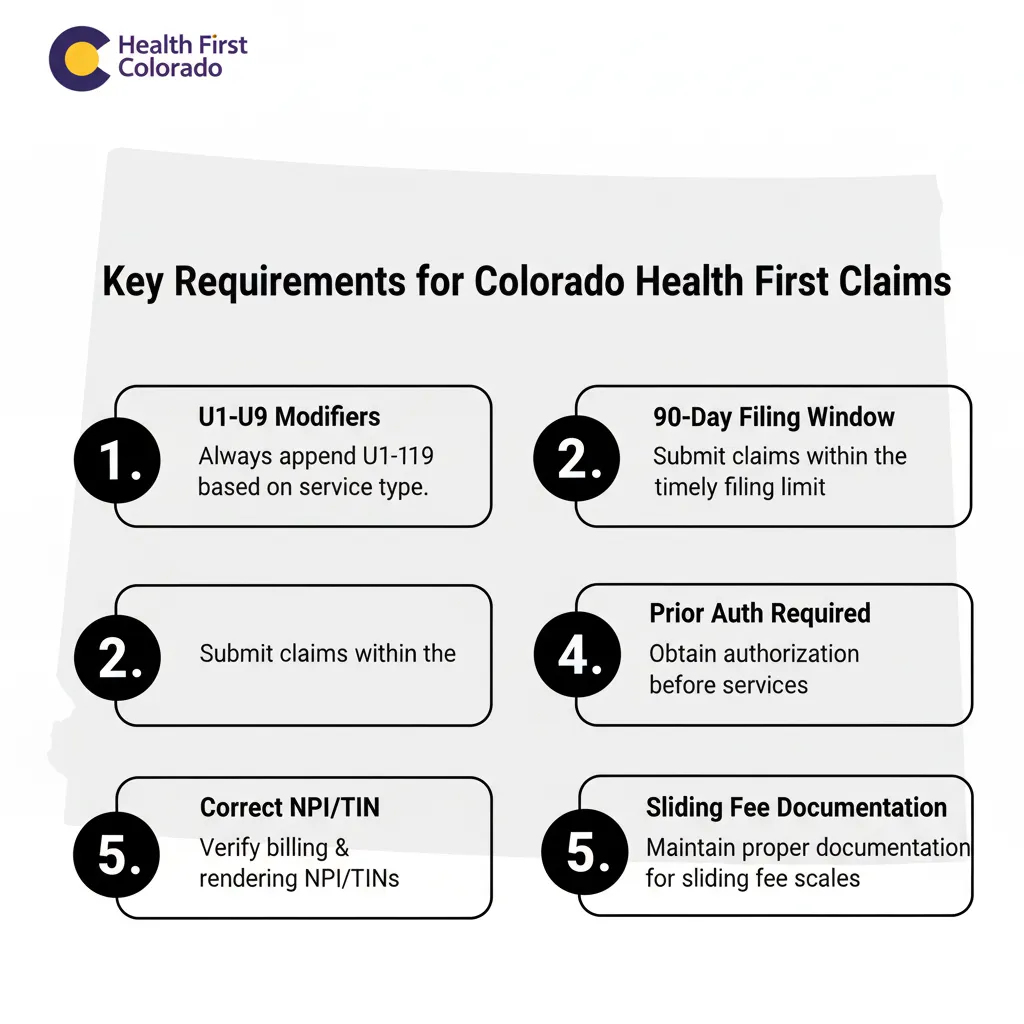
U-Codes Are Non Negotiable
Every Medicaid claim must include a U code that matches the service type.
- U1: Primary medical visit
- U2: Preventive care
- U4: Behavioral health
- U6: Dental
- U9: Enabling services (transportation, case management)
File Within 90 Days No Exceptions
Health First Colorado will not accept claims submitted after 90 days from the date of service. No appeals. No grace period.
Prior Authorization Is Expanding
In 2025, prior auth is required for.
- All behavioral health therapy beyond 6 visits
- Imaging (MRI, CT scans)
- Specialty referrals (dermatology, ortho, pain management)
- Durable medical equipment (DME)
Use the Correct NPI & TIN
- Billing NPI: Must match your Medicaid enrollment
- Rendering NPI: Must belong to the provider who saw the patient
- TIN: Must be your clinic’s tax ID not a parent organization’s
Document Sliding Fee Discounts
If you’re an FQHC or community clinic, you must.
- Verify patient income annually
- Apply discounts based on Federal Poverty Level (FPL)
- Keep documentation on file for HRSA audits
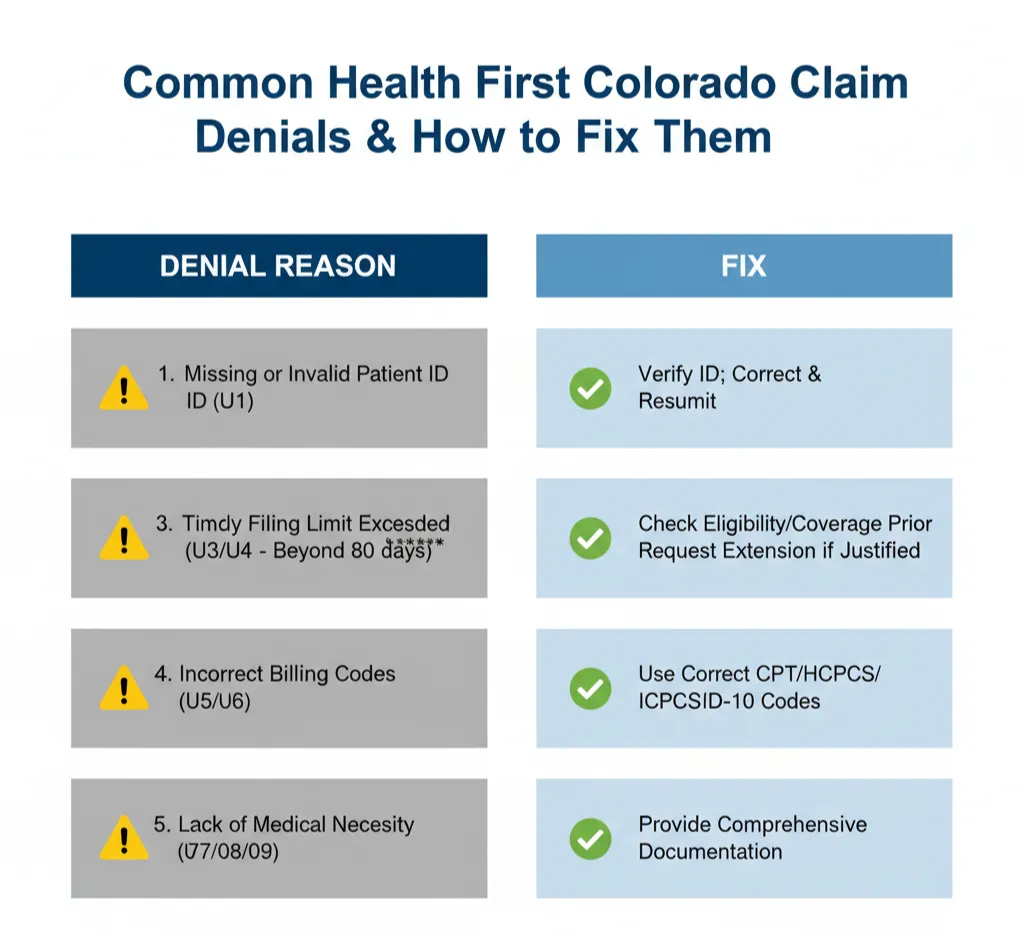
Common Medicaid Denial Reasons (And How to Fix Them)
Here are the top 5 denial reasons we see in Colorado and how to resolve them:
Why Denver & Colorado Springs Clinics Need Local Billing Help
National billing companies often treat Medicaid like a “one size fits all” program. But Colorado has its own ecosystem.
- Denver clinics serve high volumes of FQHC and behavioral health patients requiring U4 codes and sliding fee billing
- Colorado Springs providers work with military families on Medicaid adding TRICARE coordination layers
- Rural urban mix means clinics must navigate both urban Medicaid rules and rural health network requirements
A local Colorado billing partner understands:
- How to navigate the PEAK provider portal
- When to use wraparound billing for integrated care
- How to handle dual eligibility (QMB, SLMB)
How to Choose a Medicaid Specialized Billing Partner in Colorado
Look for these 5 signs of expertise.
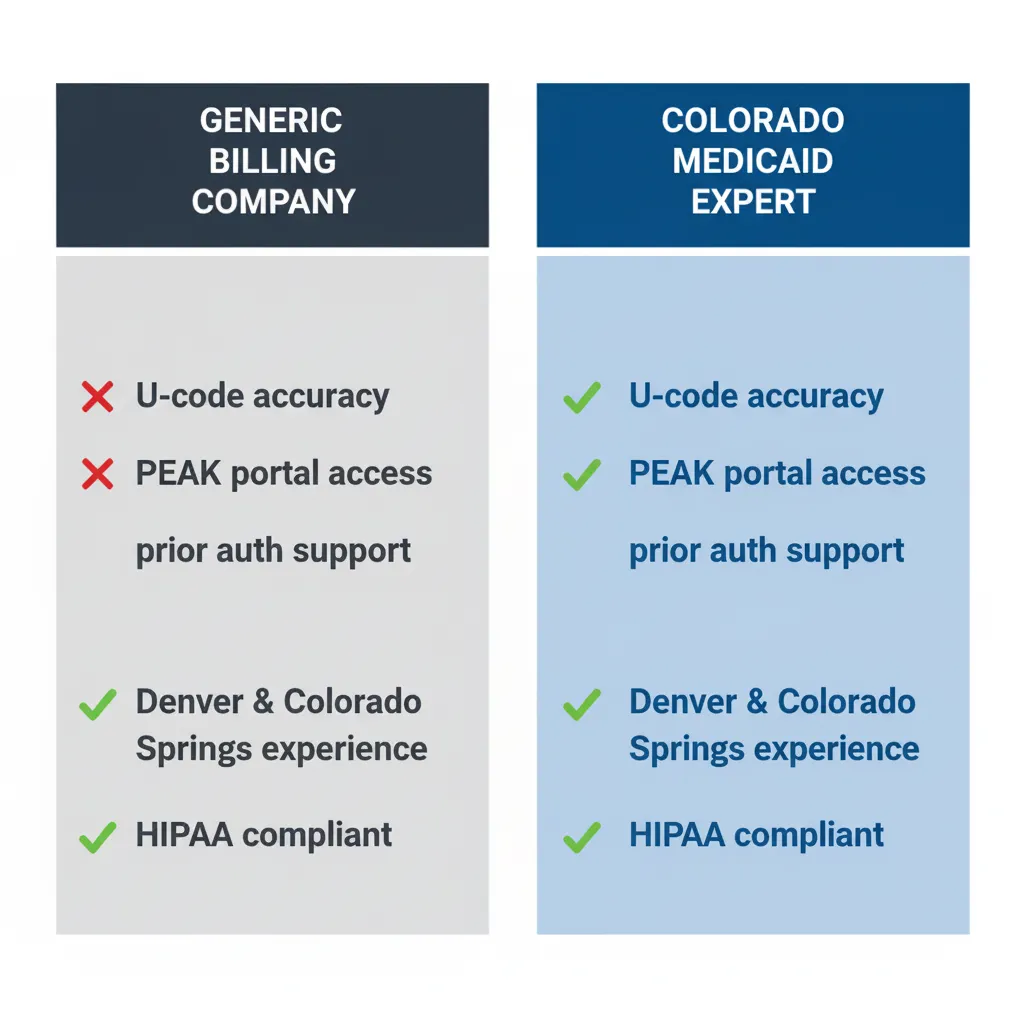
Proven Health First Colorado Experience
Avoid firms that say “we bill Medicaid everywhere” but don’t know Colorado’s rules.
PEAK Portal & UDS Familiarity
our partner should know how to.
- Submit claims via PEAK
- Pull remittance advice (ERA)
- Generate UDS-ready reports for FQHCs
Prior Authorization Support
They should handle auth requests not just tell you to do it yourself.
Real Time Denial Tracking
You need dashboards showing:
- Medicaid denial reasons
- Aging claims by payer
- U-code compliance rate
HIPAA + State Compliance
Ensure they follow both federal and Colorado privacy laws.
What to Expect When You Switch (Timeline & Results)
Most Colorado clinics see results fast.
- Week 1: Medicaid claim history review + U-code audit
- Week 2: PEAK portal integration + staff training
- Month 1: Denial rate drops by 30–50%
- Month 2: Clean claims = faster payments (14–21 days vs. 45+)
Why CureBill Is Trusted for Medicaid Billing in Colorado
At CureBill, we’ve processed 10,000+ Health First Colorado claims in 2024 alone. We specialize in.!
- U1 to U9 modifier accuracy
- 90 day filing compliance
- Prior authorization coordination
- Sliding fee scale billing for FQHCs
- Full HIPAA compliant RCM
We serve clinics across Denver, Colorado Springs, Aurora, and beyond because Colorado Medicaid deserves Colorado expertise.
Ready to Get Paid Faster on Medicaid?
If you’re a primary care clinic, FQHC, behavioral health practice, or specialty provider in Colorado, you deserve a billing partner who speaks Medicaid fluently.
Schedule Your Free Medicaid Billing Audit
We’ll review your last 30 days of claims and show you exactly how much you could recover.
To bill Medicaid in Colorado, you must enroll in Health First Colorado, use correct U1–U9 modifiers, submit claims within 90 days, and include valid NPI/TIN. Always verify patient eligibility and prior authorization before service.
U-codes (U1–U9) are required modifiers for all Health First Colorado claims. They identify the service type: U1 = medical, U2 = preventive, U4 = behavioral health, U6 = dental, U9 = enabling services. Missing U-codes cause automatic denials.
You have 90 days from the date of service to file a Medicaid claim in Colorado. Health First Colorado does not accept late claims—no exceptions or appeals.
Yes—for many services in 2025, including behavioral health beyond 6 visits, imaging (MRI/CT), specialty referrals, and DME. Submit requests 5–7 days before the service date.
The best Medicaid billing service in Denver is one with proven Health First Colorado experience, U-code accuracy, PEAK portal access, and local knowledge of Denver’s FQHC and safety-net clinic landscape.
Most Colorado Springs providers pay 4–7% of Medicaid collections to specialized billing partners. Avoid per-claim fees—they inflate costs during high-volume months.
Yes—but only if they understand HRSA rules and Federal Poverty Level (FPL) calculations. A qualified partner will auto-apply discounts and store income verification securely for audits.